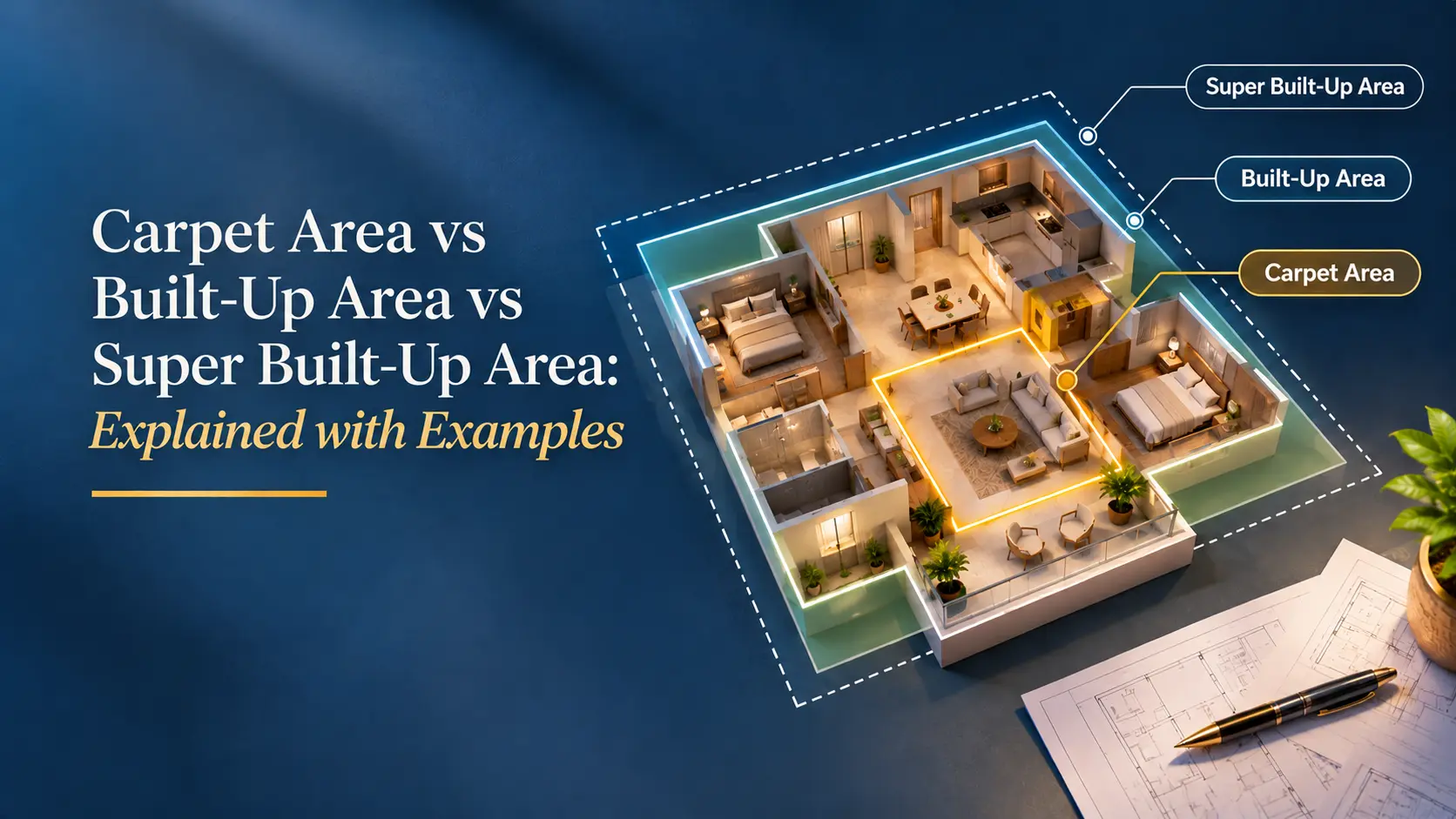
Carpet Area vs Super Built Up Area: What Are You Actually Paying For When Buying a Flat in Bengaluru?
Imagine you have shortlisted an apartment in Bengaluru. The brochure mentions 1,500 sq. ft., the price seems reasonable, and everything looks perfect when you visit the sample flat.
But when you step inside the actual apartment, something feels different. The rooms seem smaller than you expected, and you start wondering whether the 1,500 sq. ft. mentioned in the brochure is really the space you will get.
This is a common situation for homebuyers. The confusion usually comes down to three terms used in real estate: carpet area, built up area and super built up area.
Although these measurements refer to the same apartment, they represent different things. Understanding the difference can help you compare properties more accurately and avoid making a buying decision based on a number that doesn’t tell you the complete story.
Let’s look at what each term means, how these areas are calculated and why they matter when buying a home in Bengaluru.
Why Does the Same Flat Have Three Different Area Measurements?
When a builder advertises an apartment as 1,500 sq. ft., it doesn’t necessarily mean you will have 1,500 sq. ft. of usable living space.
That’s because an apartment includes more than just the rooms you use every day. There are internal and external walls, balconies and shared spaces such as lifts, staircases and corridors.
Depending on which of these spaces are included in the calculation, the apartment can have three different measurements.
For example, a flat might have:
- Carpet area: 1,050 sq. ft.
- Built up area: 1,150 sq. ft.
- Super built up area: 1,500 sq. ft.
All three figures can be correct. The important thing is to understand what each one represents.
What Is Carpet Area?
Carpet area refers to the actual usable floor space inside your apartment. In simple terms, imagine placing a carpet across the floor of your home. The area it covers is broadly what carpet area represents.
Under the Real Estate (Regulation and Development) Act, 2016 (RERA), carpet area is defined as the net usable floor area of an apartment.
It includes the area covered by internal partition walls but excludes external walls, service shafts, exclusive balconies or verandahs and exclusive open terraces.
What is included in carpet area?
- Living and dining areas
- Bedrooms
- Kitchen
- Bathrooms
- Internal partition walls
What is excluded?
- External walls
- Exclusive balconies and verandahs
- Open terraces
- Common areas such as lifts, staircases and corridors
- Service shafts
Why should homebuyers pay attention to carpet area?
Because this is the measurement that tells you how much usable space you are actually getting inside your home.
When comparing two apartments, don’t just look at the advertised square footage. Check their carpet areas as well. A flat with a smaller advertised size may offer more usable space than another apartment with a larger super built up area.
What Is Built Up Area?
Built up area includes the carpet area along with the thickness of the walls and exclusive spaces such as balconies.
Think of it as the overall area occupied by your individual apartment, including the portions that aren’t directly usable as living space.
For example, if an apartment has a carpet area of 1,000 sq. ft., the built up area might be around 1,100 sq. ft., depending on the wall thickness and balcony size.
Built up area generally includes:
- Carpet area
- Internal and external walls
- Exclusive balconies
- Other exclusive attached spaces, where applicable
Built up area is generally larger than carpet area. In many apartments, the difference can be around 10–20%, although this varies from project to project.
Why does built up area matter?
It gives you a better understanding of the total footprint of your apartment. However, it doesn’t include your proportionate share of common building facilities.
That additional portion is included when calculating the super built up area.
What Is Super Built Up Area?
Super built up area is the built up area of your apartment plus your proportionate share of the building’s common areas.
These common areas are shared by residents and may include:
- Entrance lobbies and corridors
- Lifts and staircases
- Clubhouse
- Gymnasium
- Swimming pool
- Security cabins
- Common service areas
Developers generally calculate the total common area and distribute it among apartments using an allocation method, often based on their respective sizes.
Your allocated share is then added to the built up area to arrive at the super built up area.
This is an important distinction for buyers in Bengaluru because many developers quote apartment prices based on super built up area.
For instance, you may be paying for a 1,500 sq. ft. apartment, but the actual usable space inside it could be closer to 1,050 sq. ft.
That doesn’t automatically make the pricing unfair. Common facilities have value too. However, you should know exactly how much of the quoted area belongs to your apartment and how much represents shared spaces.
Carpet Area vs Built Up Area vs Super Built Up Area: What’s the Difference?
If you’re still finding these terms confusing, the comparison below should make things easier.
| Feature | Carpet Area | Built Up Area | Super Built Up Area |
|---|---|---|---|
| What it measures | Usable floor area | Carpet area plus walls and exclusive spaces | Built up area plus proportionate common areas |
| Internal walls | Included | Included | Included |
| External walls | Excluded | Included | Included |
| Balconies | Excluded | Generally included | Generally included |
| Common areas | Excluded | Excluded | Included proportionately |
| Relative size | Smallest | Larger | Largest |
| Main purpose | Measuring usable living space | Understanding apartment footprint | Understanding the quoted sale area |
The easiest way to remember the difference is this:
- Carpet area is the space you can actually use inside your home.
- Built up area adds the walls and exclusive spaces.
- Super built up area adds your proportionate share of common facilities.
What Is Loading in Real Estate?
You may have heard property consultants or builders use the term “loading” while discussing apartment sizes.
Loading refers to the difference between the super built up area and the carpet area. It indicates how much of the quoted apartment area is made up of walls, balconies and proportionate common areas rather than usable carpet space.
Here’s the formula:
Loading Percentage = [(Super Built Up Area − Carpet Area) ÷ Super Built Up Area] × 100
For example, consider an apartment with:
- Super built up area: 1,400 sq. ft.
- Carpet area: 1,050 sq. ft.
Loading = [(1,400 − 1,050) ÷ 1,400] × 100
Loading = 25%
This means that 25% of the quoted super built up area is outside the carpet area.
In Bengaluru, loading percentages of around 25–35% are often discussed in residential projects. However, there is no single standard percentage that applies to every apartment.
A lower loading percentage can mean more usable space relative to the quoted area. But don’t judge a project on loading alone. The quality of common facilities, apartment layout and overall pricing also deserve attention.
3 Practical Examples to Understand the Difference
Let’s look at a few situations that can help you understand how these measurements affect your buying decision.
Example 1: Understanding the Three Areas of One Apartment
Suppose you’re looking at a 2 BHK apartment with the following measurements:
| Area Type | Size |
|---|---|
| Carpet area | 1,000 sq. ft. |
| Built up area | 1,100 sq. ft. |
| Super built up area | 1,350 sq. ft. |
Here, the apartment has 1,000 sq. ft. of usable carpet area, while the remaining space accounts for walls, balcony and the proportionate share of common areas.
Let’s calculate the loading:
[(1,350 − 1,000) ÷ 1,350] × 100 = 25.93%
So, the loading is approximately 26%.
When you see 1,350 sq. ft. in the brochure, remember that the usable carpet area is 1,000 sq. ft.
Understanding this difference makes it easier to assess whether the apartment offers enough space for your family.
Example 2: Comparing Two Apartments in Different Projects
Now imagine you’re comparing two 3 BHK apartments in Bengaluru.
Both projects look attractive, but their pricing and area measurements are different.
| Particulars | Project A | Project B |
|---|---|---|
| Super built up area | 1,500 sq. ft. | 1,400 sq. ft. |
| Price per sq. ft. | ₹10,000 | ₹10,500 |
| Total apartment price | ₹1.50 crore | ₹1.47 crore |
| Loading | 30% | 22% |
| Carpet area | 1,050 sq. ft. | 1,092 sq. ft. |
| Price per sq. ft. of carpet area | ₹14,286 | ₹13,462 |
At first glance, Project A might appear more attractive because it has a larger advertised area and a lower price per square foot.
But look at the carpet area.
Project B offers 1,092 sq. ft. of usable space compared to Project A’s 1,050 sq. ft. It also has a lower total apartment price.
When you calculate the price based on carpet area, Project B offers better value in this example.
This is exactly why comparing apartments only on the basis of super built up area can be misleading.
Example 3: Two Apartments With the Same Advertised Size
Here’s another situation worth considering.
Two developers advertise their apartments as 1,500 sq. ft. based on super built up area.
However, their loading percentages are different.
Apartment A: 25% loading
Carpet area = 1,500 × 75%
Carpet area = 1,125 sq. ft.
Apartment B: 35% loading
Carpet area = 1,500 × 65%
Carpet area = 975 sq. ft.
The difference is 150 sq. ft.
That’s a considerable amount of space, especially when you’re buying a home where every square foot matters.
Although both apartments are advertised as 1,500 sq. ft., the usable space inside them is quite different.
Before finalising a property, make sure you understand these numbers rather than relying only on the size mentioned in the brochure.
What Does RERA Say About Carpet Area and Super Built Up Area?
The introduction of RERA brought greater transparency to how apartment areas are disclosed to homebuyers.
Under the Real Estate (Regulation and Development) Act, 2016, carpet area has a defined meaning, and promoters are required to disclose the carpet area of apartments in registered projects.
Some important points homebuyers should know:
- The carpet area must be disclosed in the agreement for sale.
- The RERA definition provides a standard basis for measuring carpet area.
- Promoters must follow the applicable requirements for disclosing apartment details and pricing.
- Buyers should verify the carpet area mentioned in the agreement against the details provided for the registered project.
If you find a difference between the promised carpet area and the area specified in your agreement or delivered apartment, ask the builder for clarification.
If the issue remains unresolved, you can explore the complaint process through Karnataka RERA, subject to the applicable provisions.
You can also refer to our Karnataka RERA guide to understand how to check project registration and important property details.
For official information, visit the Karnataka RERA portal.
How to Compare Apartment Areas Before Buying a Flat
Understanding the terminology is useful, but knowing how to apply it during a property visit is even more important.
Here are a few things worth checking before you pay a booking amount.
1. Ask for the carpet area first
Don’t stop at the super built up area mentioned in the brochure. Ask the sales team to share the carpet area of the specific apartment you’re considering.
2. Calculate the loading percentage
Once you have the carpet area and super built up area, calculate the difference. This will give you a clearer picture of how much of the quoted area is outside your usable space.
3. Compare the price per sq. ft. of carpet area
A project advertising a lower price per square foot isn’t necessarily cheaper. Calculate the total price against the carpet area to compare different apartments more fairly.
4. Check the agreement for sale
Make sure the carpet area mentioned in your agreement is consistent with the information provided by the builder. Don’t rely entirely on verbal assurances.
5. Spend time studying the floor plan
Two apartments with identical carpet areas can feel very different depending on their layouts.
Check bedroom dimensions, passage space, ventilation, furniture placement and the arrangement of living areas.
6. Consider the common amenities
A project with a clubhouse, swimming pool, gym and other facilities may have a higher loading percentage. That isn’t necessarily a disadvantage if these facilities are genuinely useful to your family.
The idea is to understand what you’re paying for and decide whether it offers value.
Common Mistakes Homebuyers Make When Comparing Apartment Sizes
Even buyers who have visited several properties sometimes overlook these details.
Here are a few mistakes worth avoiding:
- Comparing different area measurements: Never compare the carpet area of one apartment with the super built up area of another.
- Ignoring loading: Two flats advertised at 1,500 sq. ft. may have very different usable areas.
- Depending only on brochures: Always verify the carpet area in the relevant project documents and agreement.
- Looking only at the price per sq. ft.: A lower quoted rate doesn’t automatically mean a better deal.
- Ignoring the floor plan: The layout and room dimensions can make a significant difference to everyday living.
A little attention to these details can help you make a much more informed decision.
Frequently Asked Questions
1. What is the main difference between carpet area and super built up area?
Carpet area refers to the usable floor space inside your apartment, including internal partition walls. Super built up area includes the built up area along with your proportionate share of common spaces such as lifts, corridors and the clubhouse.
2. Which area should I consider when comparing two flats?
Carpet area is generally the best starting point because it tells you how much usable space you get inside the apartment.
You should also compare the total price and calculate the price per square foot of carpet area.
3. What is the normal loading percentage in Bengaluru apartments?
Loading of around 25–35% is commonly discussed in Bengaluru’s residential market. However, the actual percentage varies depending on the project design, apartment configuration and common facilities.
Always calculate it using the actual carpet and super built up areas rather than assuming a standard percentage.
4. Is the balcony included in carpet area?
No. Under the RERA definition, an exclusive balcony or verandah is excluded from carpet area. It is generally considered while calculating the built up area.
5. Can a builder quote apartment prices based on super built up area?
Builders may quote prices using super built up area as a pricing reference. However, applicable RERA disclosure requirements require the carpet area to be disclosed. Buyers should check the registered project details and agreement for sale before proceeding.
6. How do I calculate carpet area from super built up area?
If you know the loading percentage, you can use this formula:
Carpet Area = Super Built Up Area × (100 − Loading Percentage) ÷ 100
For example, if the super built up area is 1,500 sq. ft. and the loading is 30%:
1,500 × 70 ÷ 100 = 1,050 sq. ft.
The estimated carpet area is 1,050 sq. ft.
Remember that this calculation is useful for estimation. For the actual apartment measurement, refer to the carpet area disclosed by the builder.
Final Thoughts: Look Beyond the Square Footage
Buying an apartment is a major financial decision, and the advertised square footage shouldn’t be the only thing influencing your choice.
A 1,500 sq. ft. apartment doesn’t always offer more usable space than another apartment of the same advertised size. The difference lies in the carpet area, the loading percentage and the way the apartment has been designed.
Before choosing a property, take the time to understand all three measurements. Compare carpet areas, check the floor plans, calculate the effective price per square foot and verify the details in your agreement.
At Infantry Homes, we understand that choosing a home involves much more than comparing brochures and prices. Our team helps homebuyers evaluate properties based on important factors such as carpet area, loading, pricing and overall project value.
Since 2018, we have helped more than 1,000 families find RERA-approved homes in Bengaluru.
If you’re planning to buy an apartment and aren’t sure which project offers better value, our team can help you understand the differences and make a more informed decision.
Explore our handpicked residential projects or speak with an Infantry Homes advisor.
Call +91 90715 67747 for a free consultation.